Paid or free NFL tipsters? A comparison of Warren Sharp’s subscription and Jason Logan’s public picks, including their specialities, published records, and value for UK bettors.
For UK bettors comparing NFL tipsters, Warren Sharp and Jason Logan offer two distinct approaches. Sharp sells access to NFL betting recommendations and analysis; Logan publishes free NFL picks and explanations at Covers. Before weighing the cost of either approach, it helps to understand who they are and which markets they cover.
Who are Warren Sharp and Jason Logan
Warren Sharp founded Sharp Football Analysis, a service focused on football analytics and betting research. His background is in engineering, and his company describes how he developed computer models to forecast NFL games and identify value in betting lines. His work extends to play-by-play data and season previews. For readers seeking paid NFL tips, computer-modelled totals, or bets on the combined points scored in a game, these are a prominent part of his subscription offering.
Jason Logan is a senior betting analyst at Covers, where he has worked since 2005. His NFL Underdogs column specialises in taking underdogs against the point spread, with written arguments for the selections. His wider coverage includes game previews and basketball analysis. For this NFL tipster comparison, the focus is his publicly accessible football work, particularly the underdog series, rather than every pick published by Covers.
Why Gambling Nerd selected these NFL tipsters
GamblingNerd.com selected Sharp and Logan for this comparison because they offer a practical way to examine paid and free NFL tips: a subscription with release notifications alongside a named analyst’s accessible columns. Their different specialities also make it possible to assess how the product fits a reader’s interests. This is an editorial selection for comparison, rather than a ranking of the most profitable NFL tipsters.
For this AI-assisted comparison, GamblingNerd.com reviewed their published offerings, prices, and results. Logan’s free work is the more accessible starting point for someone considering a first subscription. Sharp’s service merits closer consideration when its coverage and delivery fit the reader’s needs, and the fee makes sense at their existing stakes.
This is a review of public material, checked on 13 November 2026. It does not report a purchased subscription test or a live betting trial.
Paid NFL tips from Warren Sharp
Sharp Football Analysis advertises an NFL-only package at $89.99 for one week, $249.99 for four weeks, and $749 for its current season offer. The page describes regular-season coverage and labels the four-week option “Billed Monthly”. Readers should confirm renewal dates and the remaining coverage before paying, particularly when joining midway through a season.
The advertised service includes NFL recommendations and analysis, with computer-generated totals among its features. Delivery is through mobile push notifications, email and an account dashboard. Releases begin on Tuesday morning and continue through Sunday morning; this is a release window, rather than a promise that every selection arrives on Tuesday.
That format may appeal to someone who wants recommendations delivered as they become available. Its practical value depends on whether the subscriber can act at the quoted line. An alert received while a UK reader is at work can be less useful if the market has moved by the time they open it.
The product being assessed also matters. Sharp’s NFL offering, a combined NFL and college-football subscription, and wider packages should be evaluated separately. Results from a specialist totals subset cannot automatically establish the performance of every selection a subscriber receives.
Free NFL tips from Jason Logan
Logan’s NFL Underdogs column gives readers point-spread selections alongside the reasoning behind them. A published example shows how that approach works in practice.
The Week 9 edition, updated on 8 November 2026, listed Carolina +2.5, Green Bay +3.5 and Tampa Bay +6.5. Its accompanying discussion considered coaching changes, recent performance and market movement. These are historical examples of his published approach, rather than recommendations to place those bets now.
A free column gives readers time to judge whether the explanation is persuasive. They can compare its assumptions with injury news and the prices on their own accounts, or simply follow the analysis without placing a bet.
There are limits to that format. A published article is not the same delivery product as a subscription alert, and a short underdog column does not represent an entire slate of NFL markets. Logan’s results must also be separated from those of other Covers contributors.
Comparing the NFL tipsters’ published records
Sharp’s package page reports a 2025 record of 500–374 and a profit of 55.38 units. This is a provider-published claim, not an independently audited result established by this review. The page also promotes computer-totals figures, which describe a narrower selection category.
Logan’s Week 9 column reported a season record of 13–11 against the spread entering that set of picks. It also highlighted a recent 10–5 run. The season figure covers 24 decisions; the recent run is a smaller window within that context, not a separate full-season record.
Putting those figures in a league table would give a misleading impression of precision. They concern different years, sample sizes and selection scopes. A win percentage also leaves out the prices paid, staking differences and, for a subscriber, the fee.
A fair performance comparison would require a common period, a complete time-stamped selection history, original odds, clear treatment of pushes and consistent staking. It would then need to distinguish returns at advised prices from returns a UK follower could obtain. The reviewed material does not establish a like-for-like winner on that basis.
How much profit must cover the fee
The subscription hurdle is straightforward. At the advertised four-week price of $249.99, a bettor using $10 as one staking unit would need almost 25 net units of betting profit just to cover the fee. At $50 per unit, the hurdle would be almost five net units. Those are profit units, not counts of winning bets.
These calculations illustrate cost, not expected performance. They use dollars to match the advertised price; a UK customer’s sterling charge may also reflect currency conversion and card fees. Raising stakes to make a subscription appear more affordable would increase the amount exposed to losses.
Logan’s reviewed columns carry no subscription charge, so there is no equivalent fixed fee to recover. That improves the starting cost comparison, but says nothing by itself about whether the selections will produce a profit.
TipsterCheck’s guide to free versus premium tipsters applies the same useful test: assess returns after subscription costs at the stakes you already use.
Why the available line matters for UK readers
Suppose a tipster recommends an underdog at +3.5, but a follower can obtain only +2.5 at the same odds. A three-point defeat wins the first bet and loses the second. The team selection is identical; the wager is materially different.
Gambling Nerd explains this distinction in its guide to closing line value in The Nerd Nook Hub. Comparing an entry price with the closing market can help assess execution, although it does not guarantee profit or replace a record of actual returns.
For either analyst, a UK reader should record the publication time, quoted spread or total, odds and price available locally. A North American bookmaker quote may be unavailable on their accounts. Regularly receiving a worse number can erode the usefulness of otherwise well-reasoned analysis.
Warren Sharp and Jason Logan pros and cons
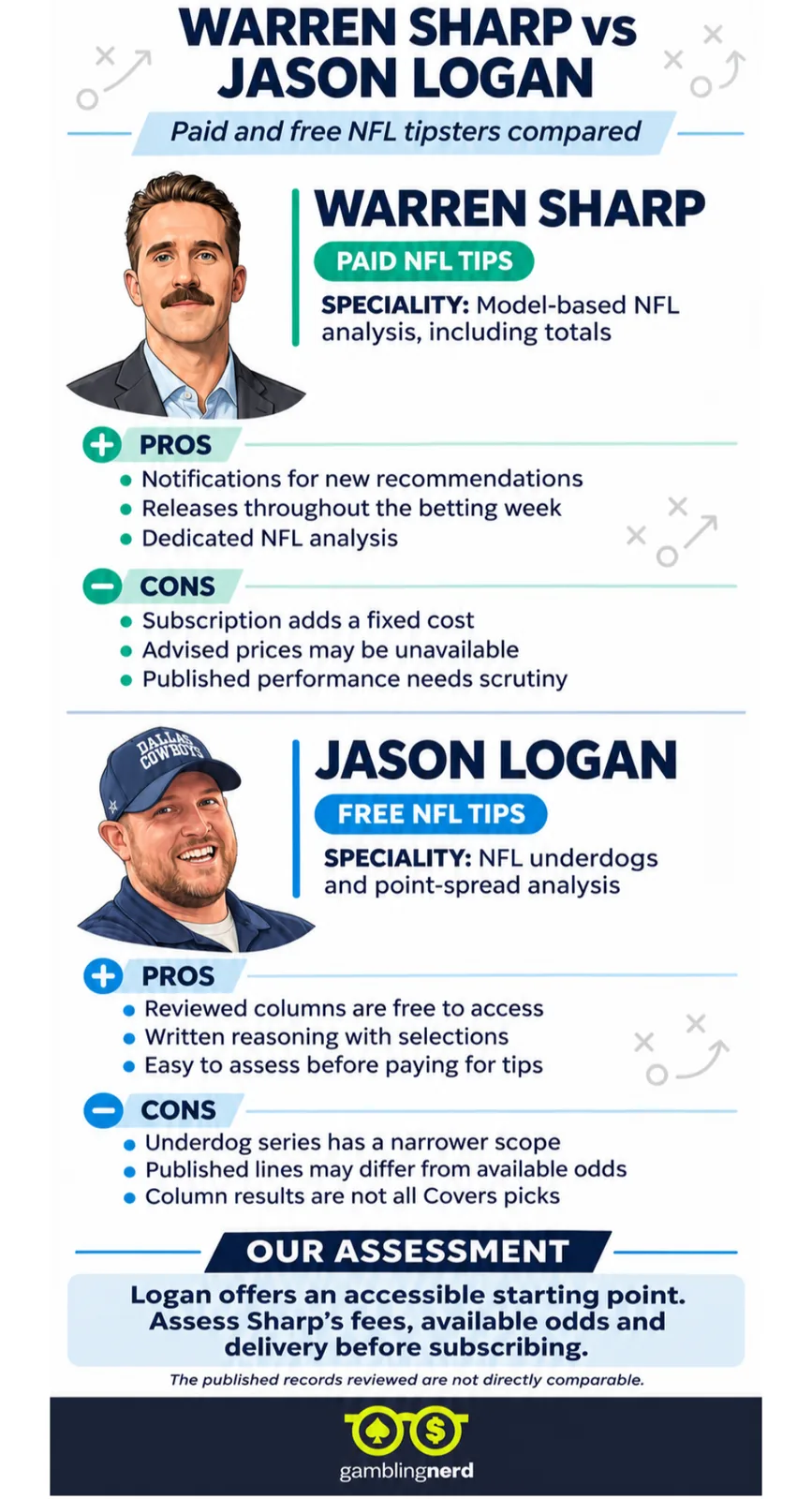
Sharp’s advantages are the advertised notification system, coverage across the week and a paid package built around NFL recommendations. The drawbacks are the fixed fee, the need to respond to releases and uncertainty over how closely a subscriber can reproduce the promoted results. Readers should ask for the record and terms of the exact package under consideration.
Logan’s advantages are accessible explanations, identifiable authorship and no subscription cost for the reviewed columns. The limitations are the narrower scope of the underdog series and the need to judge each article’s timing and available line. Public access makes evaluation easier; it does not establish a betting edge.
Which NFL tipster would Gambling Nerd choose
On the evidence reviewed, the sensible first step is to read Logan and keep a record of the prices available when his analysis appears. That allows readers to evaluate the work before committing to an additional expense.
Sharp becomes a more relevant option if someone wants that specific delivery service, can use its releases, and has enough evidence to assess the exact subscription after fees. Paying alone offers no basis for expecting better results.
The choice is therefore conditional. Logan is the more accessible starting point; Sharp requires a stronger case on cost and execution. Neither has been established here as the NFL’s best tipster, and neither removes the possibility of losing money.
About Gambling Nerd
Gambling Nerd publishes guides and analysis on sports betting, casino games and gambling mathematics. Its educational resource, The Nerd Nook Hub, explores concepts such as expected value, implied probability and closing line value, helping readers assess betting claims and understand the relationship between odds, strategy and risk.