
Dom Luszczyszyn's NHL projections have become a familiar reference for hockey fans who prefer statistics to instinct. But can the Canadian analyst's models actually help bettors identify mispriced odds, or is there a difference between forecasting a team's performance and making profitable betting selections?
Every NHL season produces a familiar argument among hockey bettors. One group trusts form, injuries and what they see on the ice. Another looks at expected goals, player impact and statistical projections.
Dom Luszczyszyn has spent years working in the second camp.
As a hockey analytics writer at The Athletic, he has developed statistical tools for evaluating players and projecting team performance. His work has attracted an audience interested in understanding why some teams outperform expectations while others struggle despite apparently strong rosters.
For the 2026–27 NHL season, his projections remain part of The Athletic's hockey coverage, including team forecasts, player evaluations and playoff probabilities.
That makes his work interesting to bettors looking for an alternative to conventional hockey predictions.
However, there is an important distinction from the outset: Luszczyszyn is a hockey analyst, not a verified betting tipster with a publicly established profit-and-loss record.
The question is whether his statistical research can help bettors make more informed decisions, rather than whether following his predictions automatically produces a profit.
Who Is Dom Luszczyszyn?
Dom Luszczyszyn is a Canadian hockey analytics writer whose work appears at The Athletic.
He is particularly associated with Game Score, a statistical measure designed to summarise a player's contribution during an individual hockey game.
The original concept was introduced in 2016 and subsequently developed to incorporate more advanced information about player performance.
His analytical work also includes Game Score Value Added, or GSVA, which attempts to estimate a player's overall value using statistical measures of offensive and defensive contribution.
These tools reflect a broader development in hockey analysis.
Traditional statistics such as goals, assists and plus-minus remain useful, but they do not always capture the full contribution of a player.
A defenceman may prevent scoring opportunities without registering a point. A forward may generate dangerous chances without scoring. A goaltender may face relatively few shots but still confront unusually difficult attempts.
Advanced analytics attempts to account for some of those differences.
For bettors, the appeal is obvious: understanding the underlying strength of a team may be more useful than reacting to its most recent results.
But useful information is not necessarily the same thing as a profitable betting recommendation.
What Does His NHL Prediction Model Actually Measure?
Luszczyszyn's work covers several different types of hockey projections, and they should not be treated as interchangeable.
His player models assess individual performance and value.
Team projections estimate expected performance across a season, taking account of the quality of the roster and other statistical information.
Playoff forecasts estimate how frequently teams reach different stages of the postseason across repeated simulations.
For the 2026–27 season, The Athletic's published playoff forecasting methodology describes simulating the NHL season 100,000 times to estimate each team's chances of reaching the playoffs, advancing through rounds and winning the Stanley Cup.
This is useful because a simulation does not have to produce one definitive prediction.
Instead, it can illustrate the range of possible outcomes.
A team might have a strong chance of qualifying for the playoffs without being particularly likely to win the championship.
Likewise, a talented roster can have a disappointing season without proving that its original projection was unreasonable.
The model is designed to estimate possibilities, not eliminate uncertainty.
For bettors, this is an important starting point. Probabilities are more informative than simply being told that one team will win.
What His 2026–27 Maple Leafs Projection Tells Us
The Toronto Maple Leafs provide a useful Canadian example.
In September 2026, Sportsnet discussed Luszczyszyn's preseason projection for Toronto.
His model estimated approximately 93.4 regular-season points, placing the Maple Leafs around 17th in the NHL and just outside the projected playoff field.
The analysis also described a broad range of potential outcomes, from approximately 78 points in a poor season to 108 points if circumstances developed favourably.
Those figures illustrate the value of presenting a forecast as a distribution rather than a certainty.
A projected total of 93.4 points does not mean the team must finish with 93 or 94.
It represents a central estimate surrounded by substantial uncertainty.
A bettor considering Toronto's season-points market could compare that projection with the line offered by a sportsbook.
If a bookmaker posted a total of 98.5 points, the model's lower central estimate might justify further investigation.
However, the difference alone would not establish a profitable wager.
The bettor would need to understand the forecast's uncertainty, the available odds, the effect of roster changes and whether the bookmaker had already incorporated similar information.
The example also demonstrates why a preseason projection becomes less relevant as the season progresses.
By November, actual results, injuries and changes in player usage may have altered the team's expected finish.
Historical projections are valuable for understanding a model, but they should not be mistaken for current betting signals.
Can Statistical Projections Identify Value Betting Opportunities?
The most important concept in evaluating any prediction model is the relationship between probability and price.
A bettor does not need to predict every game correctly to make profitable decisions over time.
Instead, the objective is to identify situations where the available odds imply a lower probability than a well-calibrated independent estimate.
Consider a hypothetical NHL matchup.
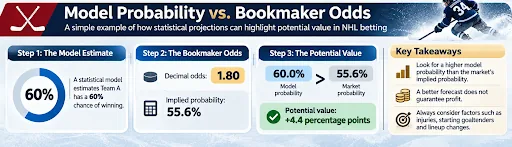
A statistical model estimates that Team A has a 60% chance of winning.
A bookmaker offers decimal odds of 1.80, equivalent to an implied probability of approximately 55.6%.
The model's estimate is 4.4 percentage points higher than the probability implied by the offered price.
If the 60% estimate is accurate and the bet settles under the same rules used by the model, the theoretical expected return is positive.
But that conclusion depends on the quality of the probability estimate.
A model can consistently overestimate certain teams, fail to account for late injuries or misunderstand the impact of starting goaltenders.
The apparent betting advantage would then be an illusion.
For Canadian readers, GambleOnline.ca's NHL betting guide explains how moneyline, puck line and totals odds work, including important differences in how overtime is treated.
Those distinctions matter when comparing statistical forecasts with sportsbook markets.
A full-game moneyline probability cannot automatically be applied to a regulation-only result or a puck-line wager.
A Critical Limitation: His Game Probabilities Are Not Betting Picks
One of the most important details for anyone considering Luszczyszyn's projections as betting information emerged in November 2026.
When announcing the return of game probabilities to The Athletic's playoff projections page, Luszczyszyn explained that the figures were intended to illustrate upcoming schedule strength.
He also warned that they did not account for starting goaltenders or specific game-day lineups.
That limitation is significant.
Starting goaltenders can materially influence NHL betting markets. A team's probability of winning may change when its first-choice goaltender is unavailable.
Late injuries, travel schedules and unexpected lineup decisions can also affect the accuracy of a forecast.
Luszczyszyn explicitly cautioned readers against treating those illustrative game probabilities as betting selections.
For anyone evaluating his work through the standards normally applied to a professional tipster, that warning deserves attention.
It would be misleading to take every published game probability, convert it into a wager and present the resulting record as his betting performance.
He has not represented those forecasts as a set of recommended bets.
How Would We Evaluate His Predictions as a Tipster?
TipsterCheck's usual evaluation criteria provide a useful framework, even though Luszczyszyn does not operate as a conventional paid betting service.
Prediction transparency
His published work provides statistical reasoning and projections rather than unexplained selections. That is useful for readers who want to understand the assumptions behind a forecast.
Historical accuracy
A credible evaluation would compare archived forecasts with actual results across a meaningful sample.
For probability forecasts, accuracy should be measured using calibration and scoring methods rather than simply counting winners.
For example, teams assigned a 60% probability should win approximately 60% of comparable events over a sufficiently large sample if the model is well calibrated.
Profitability
This is the major missing component.
There is no verified, publicly established betting ROI record attributable to Luszczyszyn's NHL projections.
Consequently, we cannot responsibly assign him a profit percentage, a win-loss betting record or a ranking among paid tipsters.
Market relevance
Season-points projections and playoff probabilities can be compared with corresponding futures markets.
However, player-value ratings and schedule-strength estimates are not directly equivalent to bookmaker prices.
Cost and accessibility
Much of his analysis appears through The Athletic, which operates a subscription-based publishing model.
Readers are paying for journalism and analytical research, not a dedicated betting-picks service.
Prediction Accuracy and Betting Profit Are Different Measures
A model can predict hockey results accurately and still fail to generate a betting profit.
Imagine a model that correctly identifies the winner of 60 out of 100 games.
That sounds impressive.
But if the average winning selection was priced at decimal odds of 1.50, staking one unit on every game would produce 90 units in total returns against 100 units staked.
The result would be a 10-unit loss, despite a 60% win rate.
By contrast, a model winning fewer than half its selections could theoretically be profitable if its successful picks were available at sufficiently high odds.
This is why the profitability of a betting tipster cannot be assessed using prediction accuracy alone.
A proper evaluation needs the original selection, the odds available when it was published, the outcome and a consistent staking method.
It should also account for the bookmaker's margin and avoid selecting only the forecasts that performed well after the event.
Without that evidence, claims that a particular analytical model can beat NHL betting markets remain unproven.
Could Canadian NHL Bettors Benefit More Than International Readers?
Luszczyszyn's work is relevant to NHL followers regardless of their country.
However, Canadian readers may find particular value in his coverage of teams such as Toronto, Edmonton, Montreal, Ottawa, Winnipeg, Calgary and Vancouver.
His models provide a consistent statistical framework for comparing those teams with the rest of the league.
That can be useful in a market where local media coverage often focuses heavily on recent performances, coaching decisions and individual players.
A statistical model may challenge a popular narrative.
For example, a team experiencing a winning streak might still have underlying weaknesses, while a struggling club might be generating better scoring opportunities than its results suggest.
Neither observation automatically creates a profitable betting opportunity.
The sportsbook may already have adjusted its prices to reflect the same information.
The potential benefit comes from using independent analysis to question assumptions and investigate whether a quoted price is reasonable.
What Would a Proper 2026–27 Betting Test Look Like?
To establish whether Luszczyszyn's forecasts have practical betting value, an independent researcher would need to conduct a structured test.
First, the researcher would archive each eligible forecast before the relevant event.
Second, they would identify a matching betting market and record the available odds at a consistent time.
Third, they would calculate the difference between the forecast probability and the market's implied probability after accounting for the bookmaker's margin.
Fourth, they would apply predetermined selection and staking rules without modifying them after results become known.
Finally, they would evaluate the results over a sufficiently large sample.
The analysis should include return on investment, closing-line value, calibration and the variability of results.
A separate out-of-sample period would help determine whether any apparent advantage persists beyond the data used to develop the approach.
For the current season, such a test would need to distinguish between preseason forecasts, updated playoff probabilities and illustrative game probabilities.
Combining them into one betting record would obscure important differences in what the forecasts are intended to measure.
Verdict: Useful Hockey Research, but Not a Verified Profitable Tipster
Dom Luszczyszyn's work provides a valuable alternative to purely opinion-based NHL analysis.
His player evaluations, team projections and playoff simulations can help readers understand how statistical models interpret hockey performance.
They may also provide a starting point for evaluating season futures and identifying differences between public expectations and bookmaker prices.
However, the evidence does not establish that his projections generate profitable betting returns.
His published game probabilities have limitations, and he has specifically warned against treating certain forecasts as betting picks.
For readers looking for a conventional tipster with a documented betting record, Luszczyszyn's work should not be evaluated as though it were a paid selections service.
For readers interested in understanding NHL probabilities, challenging popular assumptions and developing their own methods of evaluating odds, his research offers a substantial educational resource.
The distinction is fundamental: a good hockey forecast can help someone understand the game, but a profitable betting decision also requires the right price.
That is the standard any NHL prediction model should ultimately be tested against.