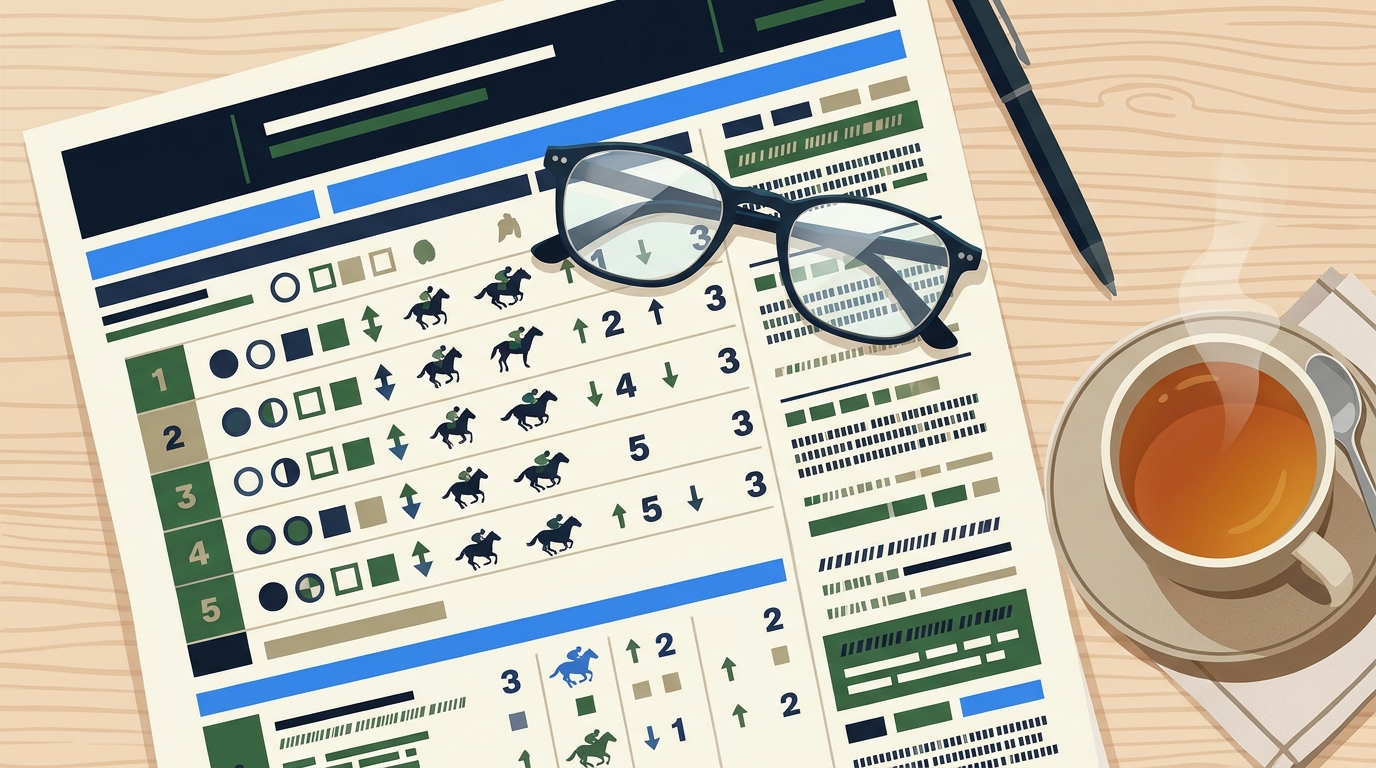
Pick up a racecard for the first time and it can feel like someone has handed you a page of encrypted code — but once you know what each section means, it becomes one of the most useful tools in a bettor's arsenal.
What Is a Racecard?
A racecard is essentially the programme for a race meeting. It lists every horse running that day, along with a wealth of information about each animal, its connections, and its recent history. You'll find racecards in print at the track, in daily racing newspapers, and on most betting websites and apps. Whether you're heading to a November jumps meeting or settling in at home, the layout is broadly the same wherever you look.
The Race Header
At the top of each race entry you'll see key details about the contest itself:
- Race time — when the race is scheduled to start
- Race name — some races have historic or sponsored names; others are simply classified by grade
- Distance — shown in miles and furlongs (e.g. 1m 2f means one mile and two furlongs)
- Going — the ground condition, ranging from Firm through Good, Soft, and Heavy; this has a huge bearing on how horses perform
- Class — races are graded by quality, from Class 1 (the best) down to Class 7 on the Flat, and by Grade on the jumps
- Prize money — the total pot on offer, which gives you a sense of the race's prestige
- Age and weight restrictions — for example, "3yo+" means horses aged three and above may enter
The Horse's Entry
Each runner gets its own row or block of information. Here's what to look for:
Stall or Cloth Number
This is simply the horse's number in the race, matching the number on the jockey's saddlecloth. On the Flat, it also corresponds to the starting stall.
Horse Name, Age and Sex
The horse's name is the most obvious element. Alongside it you'll usually see its age (e.g. 5) and a letter denoting sex: g for gelding, m for mare, c for colt, f for filly, h for horse.
Weight Carried
Shown in stones and pounds (e.g. 9-4 means nine stone four pounds). In handicap races, horses carry different weights to theoretically equalise their chances — this is one of the most important numbers to understand.
The Draw
On the Flat, the draw refers to the horse's starting stall position. At some tracks, a high or low draw is a significant advantage depending on conditions, so it's worth researching course-specific draw biases.
Trainer and Jockey
The trainer prepares the horse; the jockey rides it on the day. Both have form of their own — a top jockey booking can sometimes signal stable confidence in a runner.
Odds
The morning price is printed on many racecards, though this will shift by the time the race goes off. Treat it as a rough guide rather than a fixed figure.
Reading the Form String
This is where many beginners get lost. The form string is a sequence of numbers and letters showing a horse's recent finishing positions, read right to left (most recent result on the right). For example:
3214-1
This means the horse finished 3rd, 2nd, 1st, 4th in previous seasons (the hyphen marks a season break), then won its most recent race.
Common symbols you'll encounter:
- F — Fell
- U — Unseated rider
- P — Pulled up
- R — Refused
- 0 — Finished outside the top nine
- / — Separates different racing seasons
- - — Longer break, often over winter
Don't obsess over the raw numbers in isolation. A horse that finished 6th in a competitive Grade 1 may have run far better than one that won a weak Class 6 seller.
Weight, Ratings and the Handicapper
You'll often see an Official Rating (OR) next to each horse. This is the British Horseracing Authority's numerical assessment of the horse's ability — the higher the number, the better the horse is considered to be. In handicap races, the weights assigned are calculated from these ratings.
Some racecards also include Timeform or Racing Post ratings, which are independent assessments and can differ from the official mark. These figures are useful cross-references when assessing a field.
Trainer and Jockey Statistics
Many modern racecards include small stat boxes showing a trainer's or jockey's strike rate at the course, or their form over the past fortnight. These are worth a glance — a trainer with a strong record at a specific track is a meaningful data point, not just background noise.
If you want to dig deeper into how professionals use this kind of information, our betting guides hub covers topics from handicapping basics to understanding market moves.
Putting It All Together
Reading a racecard well is a skill that develops with practice. Start by picking one race, reading every runner's entry carefully, and asking yourself: Does this horse suit today's going? Is the distance right for it? Has the trainer been in good form? Gradually, these questions become second nature.
With the flat season winding down and jump racing firmly in its stride this autumn, now is actually a great time to start learning — National Hunt cards tend to have smaller fields, which makes them slightly less daunting for newcomers.
If you're looking for guidance beyond the racecard itself, our tipster directory lists reviewed services across a range of racing specialisms, which can be a helpful complement to your own research.
Responsible Gambling
Betting should always be enjoyable and affordable — never chase losses or stake more than you're comfortable losing. No tipster or system can guarantee a profit, regardless of their track record. If you ever feel gambling is becoming a problem, visit BeGambleAware.org for free, confidential support.