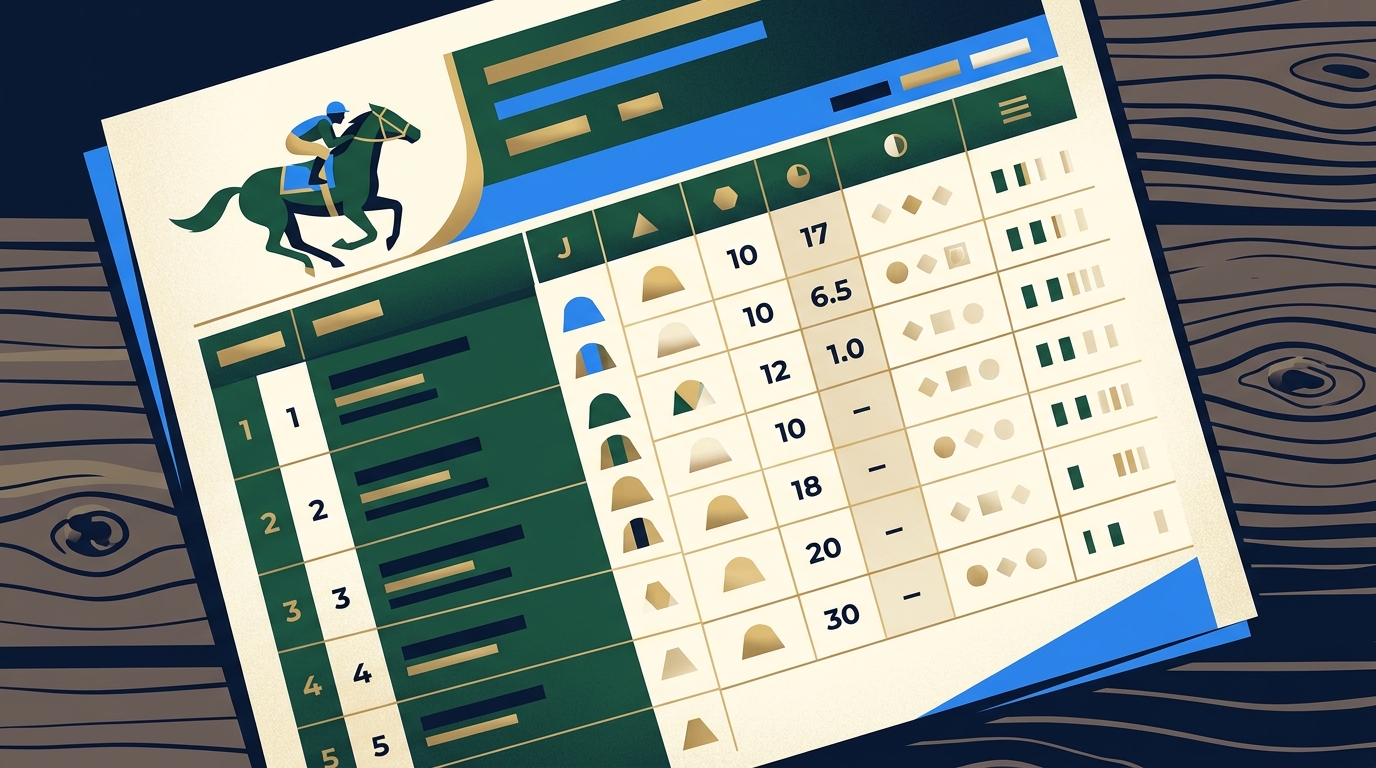
Stare at a horse racing racecard for the first time and it can feel like someone has handed you a page of code — but once you know what each element means, you'll wonder how you ever found it confusing.
What Is a Racecard?
A racecard is the official programme for a race meeting. It lists every horse entered in each race, along with a dense collection of information designed to help you assess each runner's chances. You'll find racecards on bookmaker websites, on dedicated form sites, and in printed form at the racecourse itself. With the flat season in full swing through August and some of the year's most competitive handicaps and conditions races on the calendar, it's a great time to get to grips with them.
The Basic Layout
Most racecards are organised race by race. At the top of each race entry you'll typically see:
- Race time and name — e.g. 2:15 — The Summer Handicap
- Distance — shown in miles and furlongs (e.g. 1m 2f means one mile and two furlongs)
- Going — the condition of the ground, ranging from Hard through Good to Heavy
- Class — a number from 1 (the most prestigious) to 7 (lower-grade contests), which tells you the quality of the field
- Prize money — the total pot on offer, which often reflects how competitive a race is
Breaking Down Each Runner's Entry
Each horse gets its own row or block of information. Here's what the main fields mean.
Draw
The small number at the far left is the horse's stall draw — the gate it will start from. On some flat tracks, particularly over shorter distances, the draw can significantly influence a horse's chances, so it's worth noting.
Horse Name, Age and Sex
Next comes the horse's name, followed by its age (e.g. 4 means a four-year-old) and a sex abbreviation:
- C — colt (male, four years old or younger)
- G — gelding (castrated male)
- F — filly (female, four years old or younger)
- M — mare (female, five years old or older)
Weight
Shown in stones and pounds (e.g. 9-2), this is the weight the horse must carry, including the jockey and saddle. In handicap races, weights are assigned by the official handicapper to theoretically give every runner an equal chance — higher-rated horses carry more weight.
The Form String
This is where many beginners feel lost, but it's simpler than it looks. The form string is a sequence of numbers and letters showing how the horse has finished in its most recent races, reading from left (oldest) to right (most recent). For example:
3-21F1
- 3 — finished third
- 2 — finished second
- 1 — finished first
- F — fell (common in jump racing)
- - — a hyphen separates different seasons
Other letters you'll encounter include U (unseated rider), P (pulled up), R (refused), and 0 (finished outside the top nine). A / separates years rather than runs within a season.
Trainer and Jockey
The trainer's name tells you who has prepared the horse; the jockey is who will ride it on the day. Both can be significant — certain trainers excel at specific track types or distances, and a high-profile jockey booking can be a signal worth noting.
Official Rating (OR)
In handicap races you'll see an Official Rating, a number assigned by the British Horseracing Authority. The higher the number, the better the horse is considered to be. A horse rated 100 is theoretically ten pounds better than one rated 90.
Odds
The current odds — either fractional (e.g. 5/1) or decimal (e.g. 6.0) — reflect what the market thinks of each runner's chances. These shift right up to the off, so the odds printed on a racecard are a snapshot in time rather than a final price.
Additional Symbols and Abbreviations
Depending on where you're reading the racecard, you may spot extra symbols:
- T or TP — the horse is wearing a tongue tie
- P1, P2 etc. — headgear changes (blinkers, cheekpieces, visor)
- CD — the horse has previously won at this course and distance
- BF — the horse was favourite last time out
- † or ‡ — reserve runners who may or may not take part
Putting It All Together
Reading a racecard well is about building a picture rather than focusing on one single factor. A horse with strong recent form might be carrying a career-high weight; a lightly raced youngster might be unexposed and improving. Combining what you see in the racecard with independent analysis is where real judgement comes in.
If you're looking to go deeper, our betting guides hub covers topics from understanding odds formats to interpreting pace angles — all written in the same plain English you'd expect from TipsterCheck. And if you're curious about following professional tipsters to help inform your selections, our tipster directory lets you compare verified track records side by side.
Responsible Gambling
Betting should always be enjoyable entertainment, never a financial strategy — please only ever wager what you can genuinely afford to lose. No tipster, however experienced, can guarantee a profit, and past form is never a promise of future results. If you ever feel your gambling is getting out of hand, visit BeGambleAware.org for free, confidential support.